

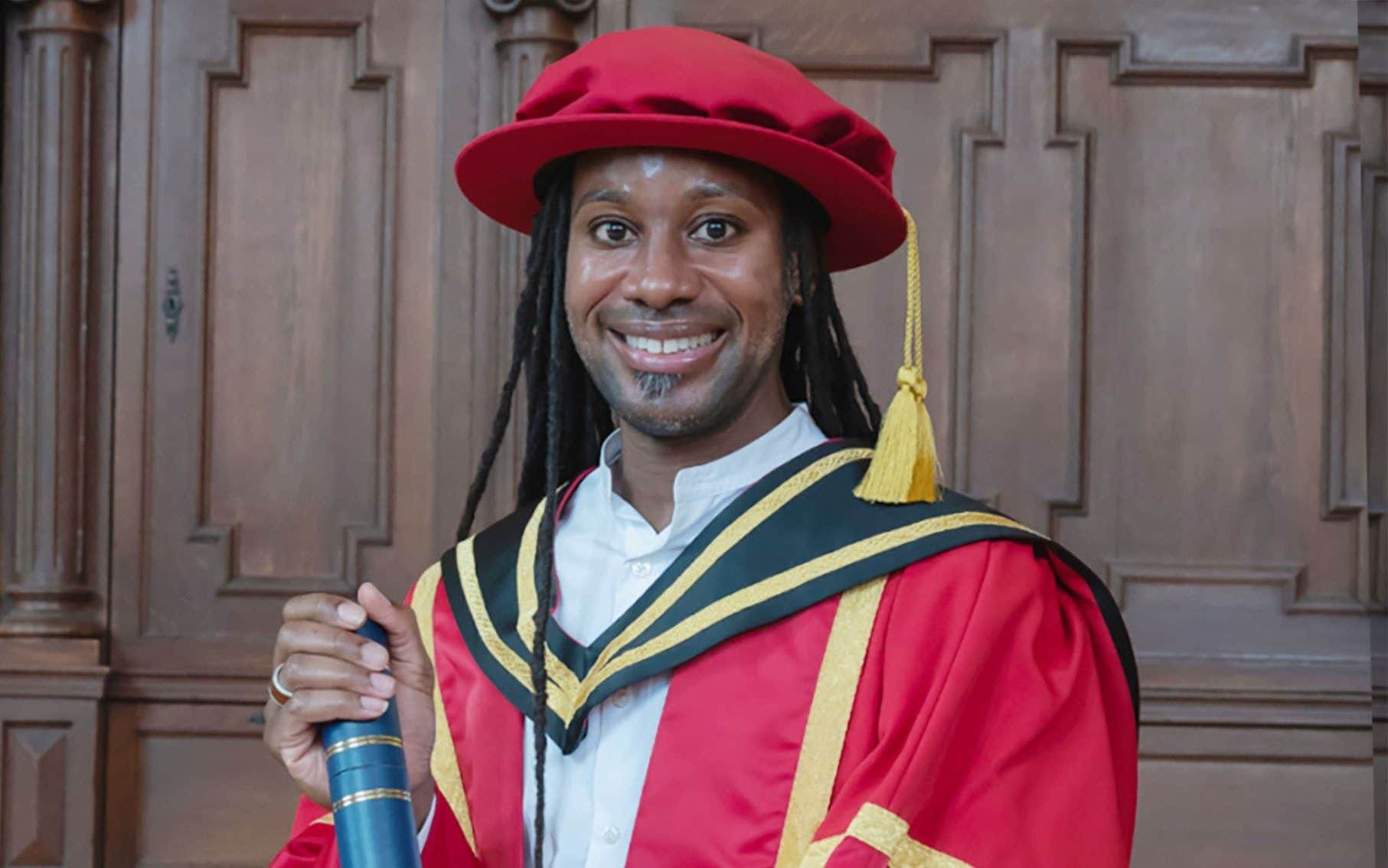
Cambridge’s youngest Black professor has resigned.
Simon & Schuster is still publishing his memoir next week for an alleged £1.4 million advance (the figure has circulated widely in reporting; the publisher has not confirmed it).
That is where we are on 7 August 2026.
On the evening of 5 August, hours after Cambridge announced it had begun an investigation into his academic qualifications and honorary appointments, Jason Arday resigned with immediate effect from the university and from Jesus College. His full statement, released through the Good Law Project, reads as follows:
Dear colleagues,
It is with profound sadness that I write to resign, with immediate effect, from my position at the University of Cambridge and Jesus College.
When I accepted the extraordinary honour of becoming Professor of Sociology at Cambridge, it was, without question, the greatest professional privilege of my life. To become the youngest Black professor in the University’s history was something I could scarcely have imagined as a child growing up with a diagnosis of autism, unable to speak until I was eleven years old.
The response from so many people across the world was overwhelming. Thousands celebrated not simply my appointment, but what it represented: that talent, perseverance and hope can triumph over even the greatest adversity. It has been the privilege of my life to teach my students, to learn alongside them, and to witness their curiosity, kindness and ambition. They have given me far more than I could ever have given them.
Sadly, the years since my appointment have also been marked by an unrelenting level of public scrutiny and personal attack. While criticism is an inevitable part of academic life, what I have experienced has gone far beyond scholarly disagreement. The relentless accusations, speculation and public commentary have taken a profound toll on me and on those I love.
I have tried to continue because I believe deeply in the values of higher education, in rigorous scholarship, and in the transformative power of universities. I have tried because of my students, my colleagues and the countless people who have written to tell me that my journey gave them hope.
But there comes a point when the personal cost becomes too great.
I have a family. I want to be present for them. I want to reclaim some peace, some privacy and some semblance of an ordinary life. I no longer wish to feel as though I am living under a constant spotlight, where every aspect of my life is subject to public examination and judgement.
For my own wellbeing, for my family, and for those who have stood by me throughout this difficult period, I have concluded that the only way to bring this chapter to an end is to step away.
This decision should not be interpreted as a loss of faith in scholarship or in the values that first brought me to Cambridge. Nor should it be mistaken for an acceptance of the narratives that have surrounded me. It is simply the decision of someone who has reached the limits of what any person should reasonably be expected to endure.
To my students: thank you. Teaching you has been the greatest honour of my academic career. Your brilliance, compassion and determination give me enormous hope for the future.
To my colleagues and to the many thousands of people, from every corner of the world, who have supported me, defended me, written to me, and believed in me when it mattered most, I offer my deepest gratitude. Your kindness has carried me through some of the darkest moments of my life.
This is not the end of my work. It is simply the end of this chapter.
I need time to heal. I need time to simply be myself again.
And when that time comes, I will return.
I will return stronger, wiser and with the same determination that has always defined my journey. There is still so much work to do, and I look forward to doing it alongside so many of you in the years ahead.
For now, however, I ask only for understanding, for compassion, and for the space to begin again.
With gratitude,
Professor Jason Arday
There is no acknowledgement of any error, no acceptance of any responsibility, and no engagement with the substance of the questions that had been raised. The resignation is framed entirely as the result of what other people have done to him. The eternal victim.
What actually triggered the Cambridge investigation
Cambridge said it had received “new information” about Arday’s academic qualifications and honorary appointments. According to The Times, the university opened the investigation after the paper presented it with new evidence that some of Arday’s research was “fabricated” and contained “impossible” evidence. That is the point at which this stopped being only a story about an unchecked biography. A national newspaper handed a university evidence of fabrication in published research, and within hours the professor had resigned.
Cambridge also confirmed that the existing complaints of academic misconduct continue separately under its research misconduct procedures. Jesus College is running its own process. The resignation does not end either.
The false claim to have published a book called Being Young, Black and Male: Challenging the Dominant Discourse with Palgrave Macmillan (a project abandoned years earlier) formed part of the same public unravelling.
How Cambridge hired him
Cambridge was under intense pressure on diversity when the post was advertised in 2023. A 2019 race action plan had set a target of reaching “at least the national benchmark in BAME professors (9.6 per cent) with actions planned to exceed national benchmark.” The job advert itself highlighted under-representation of women, Black, Asian and Minority Ethnic candidates, and those with disabilities.
The interview panel was chaired by Baroness Morgan of Huyton. Several members had publicly expressed strong support for DEI initiatives. A source with first-hand knowledge of the process told The Telegraph that the university appeared to be “just going through the motions” with other candidates because Arday was already the preferred choice.
Hilary Cremin, head of the Faculty of Education, told Arday on camera for the BBC: “We are so lucky to have you. You are the best in the world in terms of the research that you do.” She also said the university had “listened to the voices of our black scholars and our black students.”
John Preston, emeritus professor of sociology at the University of Essex, later observed that the appointment “raised eyebrows at the time… because his publication record appeared rather thin.”
Warnings that were ignored
In 2023 Dr David Harris and Professor Martyn Hammersley wrote to Cremin with evidence of textual overlaps and problems in a 2018 paper. When Harris contacted Arday directly, Arday accused him of valuing “grammar… above equity” and told him further contact would be considered bullying and harassment. Arday then reported Harris to the police. Devon and Cornwall Police declined to pursue the case.
Evidence of extensive plagiarism in the PhD was also sent to Cambridge in 2023. The university’s position was that only Liverpool John Moores could investigate. Both universities insisted nothing was wrong.
For almost two weeks after The Telegraph began publishing detailed findings, Cambridge’s public line was that Arday was the victim of a “vile campaign to undermine his credibility.”
His Supporters
Professor Sir Simon Baron-Cohen, director of Cambridge’s Autism Research Centre, wrote on 31 July that plagiarism should of course always be investigated — but that he could not stand by while an autistic man on the ground continued to be kicked. He called it relentless bullying of a vulnerable autistic man and said it was time to stop.
He is entitled to that view. The remedy for a pile-on is not to abandon the questions. I believe there should be a proper, independent, published investigation. Cambridge has finally started one, three years after it was first told. It should be published. Will it bear scrutiny though, when it is effectively marking its own homework?
Others have gone further. Green Party leader Zack Polanski signed the Good Law Project open letter of solidarity and later told LBC that “people of colour… can sometimes be held by higher standards.” He described the coverage as a “trial by media” and said the affair was “pretty sad,” while still calling for a fair investigation. Several Labour MPs and prominent academics signed the same letter, framing the scrutiny as a politically motivated smear against a successful Black academic.
The memoir and the proposal that does not match it
Great and Unfortunate Things begins in Brazil with Arday installing water pumps for WaterAid.
He writes ‘But there was another prophecy that has resonated throughout my life—one I didn’t hear until I was twenty-one years old.
It was 2006, and I was on a relief mission in Brazil, working with an organization installing water pumps in poor communities. We traveled from place to place, spending two or three days in Rio de Janeiro’s favelas—shantytowns that cling to the hillsides, stacked with tumbledown houses and shacks.
It was the middle of the day, baking hot, and the sky was a brighter blue than someone who grew up in overcast South London could ever have imagined. We were in one of the favelas, teaching a group of children how to use the new pumps so they could finally drink clean water.
I didn’t speak Portuguese, but I was paired with a local aid worker who spoke some English, a woman in her thirties with dark hair and eyes and a gentle, steady way about her. She translated my words, and together we demonstrated how the pump worked.
Then she moved towards me and rested her hand on my arm before speaking again.
“I can tell you’re destined to do great things. But I also believe you’re destined for very sad and difficult things as well.”
It stopped me cold.
“What? Any more than other people?”
After the trip was over, I never saw the woman again, but her words stayed with me and, you might say, her prediction came true.’
WaterAid have been contacted by The Telegraph, and referred them to their policy.
“Why we don’t send volunteers abroad.”
The policy states that it is vital each community manages its own projects, and that “out of respect for the people we work with, we don’t encourage or facilitate self-funded visits either.”
In short: WaterAid does not send volunteers abroad, and never has done so in the way Arday described.
His earlier speaker biographies and profiles that named WaterAid have since had the reference removed. In the memoir itself he now refers only to “an organisation” installing water pumps in Brazil, without naming WaterAid.
Daniel Engber at The Atlantic obtained the original 2024 book proposal.
It contains episodes that do not appear in the finished book: a teenage car accident that left him in a locked-in coma for months, doctors advising his parents to withdraw life support “as an act of mercy,” and a full year relearning how to walk and talk.
The memoir says only that he spent those months finishing secondary school and sitting exams.
The proposal also mentions testicular cancer, which does not appear in the finished book.
The memoir itself describes Arday as having survived two brain tumours — a claim absent from the proposal.
The 2010 blog versus the later legend — and what he told Andy Murray
In 2010 Arday kept a public blog of the “30 marathons in 35 days” challenge. There is no mention of a hairline fracture, a leg swollen to twice its size, or completing the final nine marathons while injured. Those details appeared years later.
In November 2012 Andy Murray told the press that Arday had told him he was an epileptic who ran 30 marathons in 35 days, suffered a seizure and hairline fracture on the 20th day, and continued. The contemporary blog contains none of it.
One thing that does check out: Arday was a 2012 Olympic torchbearer. A PA/Associated Press photograph shows him carrying the flame on the Sutton-to-Merton leg on 23 July 2012. Another opportunity that was undoubtedly afforded to him due to his legend.
He was never trained as a sociologist
Jason Arday has no degree, no Master’s and no PhD in Sociology. None. Zero.
His entire formal academic training is in Education and Physical Education:
BA in Education Studies and Physical Education
MA in Education and Pedagogy
A second Master’s in Education
PhD in Education — specifically on peer-mentoring among student teachers training to become PE teachers
That is a doctorate in physical-education teacher training. It is not sociology. It contains no sociological theory, no sociological methods, and no sustained engagement with the core literature of the discipline.
Yet within a few years the same man was:
Appointed Associate Professor in the Department of Sociology at Durham
Put in front of students teaching modules called Sociology of Education and Societies in Transition
Then made Professor of the Sociology of Education at Glasgow
Then made Professor of the Sociology of Education at Cambridge
At Cambridge, students in the Faculty of Education were paying close to ten thousand pounds a year. Some of that money was buying teaching and supervision from a man whose highest qualification in the subject he was employed to profess was nothing. He had never studied sociology as an undergraduate, never taken a Master’s in it, and never written a doctoral thesis in it. The word “Sociology” appeared only in the job title.
Institutions simply accepted the re-description. A PE-and-education academic was re-labelled a sociologist and students were charged elite university fees to be taught by him.
That is not an academic career progression. That is a category error that successive universities chose not to notice.
The PhD supervision
Arday has said he received only one formal recorded supervision session in two-and-a-half years. The rest of the contact with his main supervisor was by phone and text. One supervisor left and was never replaced; he never met the third. Liverpool John Moores later accepted that the supervisory team had been “depleted.” When supervision is reduced to occasional remote messages, the main practical safeguards against plagiarism largely disappear.
The 2015 doctorate examined peer-mentoring among student teachers on a PGCE in Physical Education. The title itself carries a grammatical error from the source material it closely tracks.
Fabricated and inconsistent interview data
In the 2018 Social Sciences paper, multiple quotes attributed to Arday’s own participants closely match quotes from an earlier BMJ Open study by Anjum Memon. After a correction, several quotes were trimmed or removed. Participant numbering is internally inconsistent.
Teaching and supervision at Cambridge
The Telegraph has reported complaints from students supervised by Arday.
One former MA student said: “Apart from one meeting throughout my whole course, he made a number of excuses not to meet with me or provide any substantive feedback on my work. As a supervisor, he was terrible.” Any feedback given was that the work was outstanding and supervision was not needed. The student received a lower grade than expected, appealed on the grounds of poor supervision, and the appeal was rejected.
Another student asked to change supervisor and was accused of racism but was eventually allocated a new supervisor. An undergraduate complained that scheduled hour-long sessions routinely lasted only 20 minutes.
Alongside the formal complaints about supervision, comments have circulated from people identifying as former students describing a pattern of lateness, sessions that consisted of Arday sitting on a desk and talking at length about race and celebrities, and a general absence of structured academic content. These accounts remain unverified by named individuals in mainstream reporting. They do, however, sit alongside his own on-the-record description of his teaching style — “I don’t talk about theories. I tend to talk more about life” — and raise the obvious question of what, precisely, students were paying Cambridge fees to learn from him.
Football
In the Talking Matters podcast Arday said he spent “a handful of years” at Crystal Palace as a youth player and then went on to play semi-professional football. Crystal Palace say they hold no records from that period. No semi-professional club has ever been named. The Telegraph asked directly which academy and which side; no answer has appeared. His memoir mentions neither.
The only club that can be independently linked to him is Battersea Park Rangers. A Jason Arday appears on the FA’s Full-Time listings for their Vets side — an over-35s recreational team in the Southern Amateur Veterans League. This is Sunday-morning veterans football, completely outside the National League System. It is not a step on the ladder to professional football. It is the opposite end of the spectrum.
A 2023 profile carried a photograph of him accepting an award on the club’s behalf in 2018 under the caption “Jason almost became a professional footballer.” The caption is doing a lot of work. Playing for a veterans recreational side in your late thirties does not constitute almost becoming a professional. It is ordinary Sunday football for men who enjoy the game.
He has claimed a professional academy and a semi-professional career for years. He has never named either. When a national newspaper finally asked, he did not answer.
Snooker
He has said he did even better at snooker than football, practised for seven hours a day whilst he should have been at school, won substantial sums, and was “on the verge of turning professional.”
CueTracker records one match: English Amateur Championship, Round 1, 10 February 2002, against Matthew Tugby, lost 4–1. It is the only tournament and the only match on his record. There is no professional tour record.
The epilepsy claim and the bracelet
Daniel Engber in The Atlantic reporterd that in his memoir, Arday alleged that as a teenager he was beaten so severely by a group of boys at a bus stop that he developed epilepsy for which he wears a bracelet. When the attackers were arrested, he told the judge he did not want them sent to prison.
Years later, while briefly teaching at an unnamed London university, two of the same young men turned up as his students. According to the memoir they had been so moved by his act of mercy that they had turned their lives around and were now coaching other at-risk youths. They hugged him; one asked him to be godfather to his child.
Engber notes that the book’s fact-checker did not respond when asked whether this (and several other dramatic stories) had been verified. The 2024 book proposal also told the beating story with slightly different details (the attackers were four years older rather than the same age).
The diagnosis that does not fit the criteria of its time
Arday has said, repeatedly, that he was diagnosed at the age of three (around 1988) with a “hybrid” of global developmental delay and Asperger’s syndrome.
There are two immediate problems with that claim.
First, Asperger’s syndrome was not an official diagnostic category in 1988. It only entered the major classification systems in the early 1990s (ICD-10 in 1992/93 and DSM-IV in 1994). Before that it was a research concept, not a standard diagnosis a clinician in Britain would routinely hand to a three-year-old’s parents.
Second, even after it became an official diagnosis, a defining requirement of Asperger’s was the absence of any clinically significant general delay in language. The criteria required single words by age two and communicative phrases by age three. Arday’s own account is that he was non-verbal until eleven and communicated by sign language. That is the opposite of the language profile required for Asperger’s.
A child who could not speak until eleven could not, under the criteria that eventually existed, have been given an Asperger’s diagnosis. And in 1988 the label was not yet available in the official manuals at all.
Global developmental delay is a descriptive term used for young children whose development is significantly behind in several areas. It is not a specific diagnosis that pairs with Asperger’s in the neat “hybrid” form Arday has repeatedly described.
The story therefore requires a diagnosis that was not formally available at the time, applied to a language profile that would later have ruled the same diagnosis out. No independent clinical records have ever been produced to support it.
The timeline that collapses under its own weight
Arday has said, repeatedly and in print, that he was non-verbal until eleven and could not read or write until he was eighteen.
He has also said he left school with only two GCSEs — PE and Textiles.
How is that possible? GCSE Textiles requires a design folder with written research, annotations and evaluations, plus a written exam. You cannot complete the coursework or sit the paper without being able to read and write. The same problem applies to the BTEC that supposedly followed: entry normally requires GCSEs in English and maths, and the course itself is built on written reports and assignments. Completing either while functionally illiterate is not something that happens under ordinary rules.
Yet the story requires exactly that sequence, with no independent record ever produced to show when literacy was actually achieved.
He has also described spending seven hours a day playing snooker instead of attending school. That may explain the two GCSEs — but it does not explain how someone with that level of school attendance and those results then progressed to a degree, two master’s degrees and a PhD.
The leap from two GCSEs and patchy school attendance to a professorial chair in sociology at Cambridge has never been independently verified or made to add up. It was simply repeated until it became the official story.
That is not an origin story. It is a series of unresolved contradictions that were treated as too useful to examine..
He left school with two GCSEs, has described scoring 9 per cent on his first college test at 20 “for writing his name,” and has said that by the time he started his master’s he was still reading at the level of a three-year-old. Yet he completed a BTEC, a degree, two master’s degrees and a PhD. The sequence has never been reconciled with any independent record.
Positions that institutions say do not exist or do not match
University of Glasgow: “was never a Visiting Professor here.”
Ohio State University: no record of employment.
Claimed master’s in psychodynamic counselling/practice from Birkbeck: They state he has not studied there.
Claimed published book with Palgrave: never existed.
The apparatus of success
ITV Cultural Advisory Council. Sessions for aspiring vice-chancellors. Shaw Trust Disability Power 100 (listed fourth). Named among the most influential people of 2023. Genius Within Neurodiversity Achiever of the Year (2023). Patron and trustee roles. Honorary doctorates. Speaking fees and the alleged £1.4 million memoir deal.
All of it rested on the same largely unverified origin story.
The cost of not checking — and the real victims
People keep asking whether we should feel sorry for him.
No.
This was not a series of unfortunate misunderstandings. It was a sustained pattern of exaggerated and fabricated claims about adversity, athletic feats, charity fundraising, academic positions and research data, used to secure appointments, platforms, status and money.
Better-qualified people lost out. Julie Bindel has said she personally knows two women from disadvantaged backgrounds — both, in her view, far stronger candidates — who were passed over for jobs that went to Arday.
Students at Cambridge paid for expert supervision and, according to The Telegraph, received minimal contact, excuses, and the repeated assurance that their work was “outstanding” and needed no further guidance. Some appealed. Some asked to change supervisor. One was accused of racism for doing so. That is not a victimless process.
Every time ordinary questions were asked, the response was lawyers, police reports, or accusations of racism and harassment. Three separate people who raised evidence-based concerns were reported to the police. None of those complaints was pursued.
The resignation statement frames the entire episode as an unrelenting campaign of personal attack that became too much to bear. The scrutiny was not unprovoked. It was the inevitable result of years of extraordinary claims that did not survive examination, combined with a consistent strategy of treating anyone who examined them as the aggressor.
He brought this upon himself. The institutions that elevated him without proper checks share the responsibility. The people who lost opportunities, and the students who received inadequate supervision, are the ones who paid the price.
No, I do not feel sorry for him.
The bill that never arrived
Students paid nearly ten thousand pounds a year to be taught by a man who had never studied the subject he was employed to profess.
Better-qualified candidates were passed over.
Journalists who asked ordinary questions were reported to the police and threatened with lawyers.
Institutions that should have checked looked the other way until the story became impossible to ignore.
Jason Arday built a career, a public profile, a six-figure memoir deal and a Cambridge chair on claims that did not survive basic scrutiny. When the scrutiny arrived he reached for every available defence — racism, disability, mental health, Carter-Ruck, the police — and still the claims collapsed.
He has resigned. The investigations continue. The book is still scheduled. Liverpool John Moores still says the PhD stands. Cambridge has opened an inquiry three years after it was first warned.
None of that returns the posts, the fees, the years, or the credibility that was spent defending a legend no one properly examined.
The scandal is not only what he claimed.
It is how long so many people chose to believe it.
This article is written in good faith, having assessed the evidence available to the best of my knowledge. This is my personal assessment of it. Professor Arday denies the allegations of plagiarism and has said he is the victim of a racially motivated campaign. Liverpool John Moores University has stated that his PhD still stands. The University of Cambridge has opened an investigation into his academic qualifications and honorary appointments.
I write about policing, justice and the things institutions would rather we did not say – drawing on 21 years of police service. If this reached you, share it. Subscribe for upcoming articles directly to your inbox.
This piece is free to read, but let me be honest with you, as I always try to be. I have severe M.E. – a chronic illness that limits my energy, my concentration and what I can do in a day. The job I loved broke my health. Writing something like this costs me: it means crashes, days lost, exhaustion that’s hard to describe. I take days, sometimes weeks, on each article. It would be the sensible thing not to do it at all. I do it anyway, in the small way I can, because the truth and justice matters.
If this work means something to you, a paid subscription at £5 a month helps me keep writing. So does a one-off through Buy Me A Coffee. Neither is expected. Both are genuinely appreciated – and if you can’t, sharing this costs nothing and matters just as much. Thank you for not looking away.
If I were one those students who had been assigned to his supervision - or even lectures - I would be suing Cambridge University for damages.
Whilst not as serious as being operated on by an unqualified surgeon, it is still a serious case of fraud.
The university took tens of thousands of pounds in tuition fees and then failed to deliver said tuition by a properly qualified and competent tutor...........and then vilified anyone complained.
Makes you wonder how many Jason Ardays are there out there in all walks of life. DEI hires who have no business being in their roles and of course their victims. Properly qualified folks who should have got the job but didn’t. I’d make an educated guess at quite a lot. However I am a white bigoted middle aged male heterosexual who has carried a bag of privilege around with him all his life - or so they say!